Thursday, May 28, 2009

Questions: Gnostic Theodicy

I have a question about the Gnostic explanation for the evil in the world. If the Demiurge is responsible for this flawed creation, why would the true God create the Demiurge? If this true God is perfect, why would it allow lesser deities to emanate from it? Why does it emanate in the first place? It seems to me that the Gnostic explanation for the problem of evil comes back to the same dilemma as the other explanations.
That your formulation of it comes down to the same problem is to be expected. The 'problem of evil' (aka, theodicy, justness of God) is a result of a particular theological definition of God as: all-good, all-powerful and all-knowing. Since it is a definitional problem and not a situational one, any situation in which you place that definition will result in that same problem. The reverse is also true, if you do not have that definition then you do not have that problem. Gnosticism doesn't have that theology and so doesn't have that problem.

Mythology is not theology, and the Gnostic approach is mythological rather than theological. Also, using the term "evil" invokes a larger dualistic frame that isn't necessarily any relation to the ancient thought on the subject. The Greek word is kakos, which means: bad, ugly, ill-born, unskilled, unlucky, foul, pernicious, wretched, etc. We get 'cacophony' from kako-phonos meaning "bad/ugly sound."

The explanation for endemic kakos in Valentinian Gnostic mythology is that the half-maker (demiurge) was created apart from the emanation of the ultimate divine source, and was then hidden in a fog and so was ignorant of the divine. The half-maker as a kakon (unskilled) creator then begins to create the powers (archons) and the cosmos. This story gives an explanation for the kakos (badness, ugliness, wretchedness) that is an endemic aspect of the cosmos and also the ignorance of the powers that are a part of it--it is separated from the divine and ignorant of it. This also shows the remedy, which is the reason for, point of, the myth.

The word "perfect" is another translation that invokes an anachronistic meaning frame. The two applications of telos are "without blemish," and "end, completed." In contrast, we combine and amplify the two in our use of "perfect." However, the ultimate divinity can be without blemish and still undergo a process such as emanation.

As far as the 'why' of emanations in the myth, it is also probably best understood as descriptive of the many ways in which we experience the divine (with ourselves being an aspect of such experience), and so as showing the way back to the divine. It can also be viewed as the original divine unity going through a process of realizing its different aspects through emanating (hypostasizing) those aspects.

Saturday, May 16, 2009

Linens from Catholic Linens

You can tell that it is getting close to my seventh sacerdotal ordination anniversary if you look at my old altar linens. The set I had been using was an ordination gift from Fr. Michael Laferty, being both aesthetically pleasing and also of sentimental value. So, it was even more unfortunate when I wore holes along a crease of the purificator. The amice that I had been using was already well into the process of coming apart months before. It was time, that is, I was forced to get a new set of linens.

I shopped online, looking for something inexpensive that might work. Donations don't cover regular expenses and holy week was coming up. I was torn between cheap and something that would hold up to use and so last much longer. I came across catholiclinens.com that was offering 100% linen linens for about the price of 51% linen linens. The proprietor offers quality and durability rather than lace and embroidery. She also offers larger sized amices.

My order arrived much faster than I was expecting, even though I ordered a larger size amice. I have been quite pleased with them. Pure linen is much more absorbent and more durable. You really notice the absorbency when you use the lavabo towel. As someone who sweats under all the layers of vestments, the large amice is very nice. The linen absorbs more, and with the larger size there is more of it. It really helps protect stoles and chasubles.

The red crosses are very basic, five cross-stich "x"s. The linens come pressed and creased correctly, with the exception of the purificators (they are folded in half rather than a trifold).

Friday, May 08, 2009

Icy Cold Blast from the Past

I would like to say, “well, now I have seen it all,” but that is a statement easily falsified by further events.

Some time ago I spent time on a forum, I said I was a Gnostic, they said they were Gnostics. There were occasional useful/non-polemical discussions at the very beginning. It seemed nice to find other Gnostics, and be Gnostics together. By now you should have guessed what the issue would become—that name-space “Gnostic.”

The problem seriously emerged when an attempt was made to define that name-space. When urged to caution, the charge was made “we have to do it to exclude the sex magic and new age groups!” Despite the many problems with that 'reason,' the push went aggressively on. Dissent is rarely popular by definition, and for such a grand scheme there was no opt out option, it was the entire name-space remember. A vocal dissenter is a persona non grata. The definition was presented as a fiat accompli, one of many such 'conclusions.' It was presented without an argument in its favor, the burden being on others to successfully convince those responsible for it that they were in error. Yes, it was that scholarly of a debate. “Here's my conclusion, convince me I'm wrong,” is not a caricature since identification with the conclusion stated was the norm, with arguments against being taken personally. Did I mention that these were the moderators of the forum?

Of course, it only got worse. In effect, if you disagreed with the definition of the name-space you were telling others that they were not Gnostics. Be part of the collective, or you are attacking the 'aggrieved' other parties. It was all about identity. It was the worst instance of identity politics. Simply not affirming the proclamations of some became “saying they weren't as good as you,” or, “saying that they were bad Gnostics.” It certainly wasn't the case that the 'aggrieved' weren't sincere, just that it was not a rational reaction by any means.

And, it got worse. The right to be a distinct individual with a different view on anything Gnostic was completely abrogated in practice. Any post making a distinction in regards to my own understanding and actual practice of Gnosticism was attacked by many respondents in ways that violated the forum rules. The only response of the moderators was to promptly close the entire discussion.

So, I was effectively silenced. Oh, the moderators did discuss me in their private forum, which they either forgot I had access to or just didn't care. Other moderators were asked to close discussions so it wouldn't seem biased on the surface that one of those involved actually closed them. Juvenile nicknames were used for me. A significant personal bias against my church and bishop was evidenced on a number of occasions. After seeing all that they were about, I left.

Yes, even after I left it got worse. I was pursued and hounded at another forum for the same sin of disagreeing. It may have done the trick of putting me off forums all together and effectively silencing me yet again. Fortunately, the moderators of that forum actually intervened to remove the personal attack made by a moderator of the first forum. There is much to be said for standards.

That was years ago, but the same people are doing the same things and whining and insinuating the same things. While about the most seriously creepy thing that I have experienced in my online dealings with those who call themselves Gnostics, I like to think that I have learned from the ordeal.

What comes most to mind is that community actually means being able to be distinct and to make distinctions. If you cannot be distinct it is not really a community, it is an identity. Dialoging is easiest with those who won't have identity-crossover with you, that is, for whom you do not play a role in their identity. When there is a similarity, caution is needed, as are perhaps new qualifiers for distinctions within your shared idea or name-space. To actually share things in common, we need to be able to share our distinctions and differences; after all, they are what we have to give each other.

One of the big lessons I learned is to actively remain agnostic about people and groups encountered online. When all you can know about them is what they say and what others say, it goes without saying that there is no gnosis involved. One can easily make a false-recognition out of a desire to either uncritically include or reject. Staying agnostic is what the ancients would have called a spiritual exercise, a practice of remaining aware of the difference between gnosis, doxa, and episteme.

I studied the scholarship on Gnosticism for years and had my own developing understanding from experience before encountering any practicing Gnostics, and I was quite skeptical about them, with many tests they had to pass both formulated and vague. Yet, somehow when this started, my policy was to accept anyone as they said they were, until proven otherwise. I had become ego-identified with being Gnostic in the usual way of such things so that I unconsciously identified with others who identified the same way. While a common and well-studied psychological effect, it is no less a failure on my part.

I also think that I have acquired more skillful means of communicating by that long exercise in not communicating. If someone misunderstands your argument, you can try to learn to argue more clearly. However, if someone twists your plain text in order to 'misunderstand' you, they are attacking you and not your argument, and that fact is all that there really is to learn.

The other lesson that gets driven home all too often is that if someone is attacking you in this medium, you probably cannot help them in any way. The reason for this is that anything you say will be twisted, and there is no “reality factor” that has to come into play. The interpretation by the individual does not have to be subjected to reason, facts, or simple reality tests—in this medium the interpretation by each isolated individual can be unassailable. However, I don't know if it will keep me from trying. After all, in the worse case, it only brings in a more personal animosity against me in particular.

Wednesday, May 06, 2009

TM Polemicizes (Poorly)

I came across a bit of polemic while trying to find information on Ecclesia Pistis Sophia, a recent church of "Sophian Gnosticism." ("Gnostic” and “Gnosticism" are used in a vague general way by the EPS, not in reference to ancient Gnosticism.) I have no desire to speak ill of the individual I'll refer to semi-anonymously as TM or his approach. Filtering the Gnostic myths and symbols through Kabbalistic myths and symbols isn't my cup of tea, but it seems to work for some on their spiritual journeys, and I wish every sojourner the best. However, I would like to reply specifically to some mistaken views expressed by him in one of his postings, since they seem to be views of my own tradition, and because they are just bad arguments.
Of course, rather than the cosmology of the Valentinian Gnostic tradition we draw upon the Jewish Kabbalah, generating a Christian Kabbalah; but many of the basic principles remain much the same. The difficulty is that, in truth, no one really knows the Valentinian Gnostic cosmology in its original intention and context – there must be much guess work and speculation filling in the gaps. This is not the case, however, with the Kabbalah, but there are plenty of source works and it remains a living tradition, so that when we draw from its teachings we may know the original intention and context, and when we shift the teachings to form our Christian Kabbalah we can do so with this knowledge and understanding.
This statement says that the ancient Gnostic traditions are at a remove from us. While it exaggerates the difficulty in understanding the original intention and context of Valentinian cosmology, the fact that it wasn't handed down to us as a living tradition is quite obviously true. This is given as the reason for choosing to use the Kabbalah as a core tradition, it is a living tradition as opposed to the Valentinian one. This statement makes sense. I could hope for the presentation of the results of this to be called "Sophian Kabbalah" rather than "Sophian Gnosticism," but it is a valid argument for the pragmatic choice that was made to teach a Kabbalistic core rather than a Gnostic one. One can also quote such scholars as Gershom Scholem about the Kabbalah being "Jewish Gnosticism," and the resonance between the two traditions, though they remain quite distinct.

Many in my tradition study the Kabbalah quite extensively, including the tradition of Christian Kabbalah, but it is not our core tradition—for that we use the ancient Gnostic tradition. It is a situation that can result in a somewhat steep learning curve in order to understanding the ancient context and intent of ancient scriptures (there is also a steep curve in beginning to study Kabbalah), but it does not require guesswork or speculation as a basis for practicing as modern Gnostics. The reason for this is gnosis, which most often can be translated as recognition or acquaintance. We come to know our selves, our cosmos, and the teachings, myths and symbols of our scriptures, through recognition and acquaintance—through gnosis. Gnosis is not the end of the path it is the method, that is, the path itself. Following the path of Gnosis we use study and experience of the myths, symbols, and teachings of scripture, individual spiritual inquiry, and developmental spiritual practices, in particular the mysteries/sacraments. These reflect and illuminate each other through gnosis.

However, somewhat opposite reasoning from the quote above is used against us modern practitioners of plain old (as in ancient) Gnosticism.
In this regard, I’m quite amazed that often times modern schools of Gnosticism become so bound up in orthodox patterns of priesthood, the formula of the Mass and so forth, and I’m astounded that this, very often, is how “Gnosticism” is interpreted and presented...
We actually view this in similar terms outlined in the first quote. We are choosing to practice a living tradition of ancient mystery ritual practices, a majority of which were practiced by ancient Gnostics, at a time when any specifically Gnostic tradition of practice has been long lost. However, according to TM, such a choice is not possible in this context, instead we must be "bound up in orthodox patterns." Apparently, we cannot look at the ancient Gnostic sources and see that they had mystery ritual practices, that they shared some of these with the universal church, and also that Gnostic schools functioned within the universal church, then make a choice to base our practice on a living tradition, rather than make one up largely out of guesswork and speculation. We would much rather have a living tradition of practice than one of cosmology.

Of course, when speaking of others it is easy to only consider the rules applied one way. In psychology we call this an instance of the fundamental attribution error.
If this is the case, then naturally our ancient Gnostic brothers and sisters would assume that their modern counterparts would generate their schools upon actual gnosis of Christ; specifically, actual gnosis of the Risen Christ.
If that were the case, then naturally we would expect you to generate your school upon actual gnosis of Christ, rather than on the tradition of Kabbalah. (Don't you hate it when someone turns your own argument against you by replacing terms?) You see, it doesn't matter who makes them, polemical arguments are generally bad arguments.

TM does talk quite a bit of sense about gnosis, and expresses valid though misplaced concerns. For the most part he's preaching to the choir. But from my point of view, such concerns point more towards his own group. He would seem to agree that Gnosis is not some esoteric knowledge that you have but knowledge that you are. Yet, couching everything in such a complex esoteric system as Kabbalah strikes me as somewhat counter-productive. Especially if someone can come and potentially experience gnosis of the living Christ through participation in a Eucharist service, with no need to learn a system. He merely assumes that the ancient mysteries practiced by Christians were not born out of Gnosis. Yet, there are scholars who think that the sacramental aspects of Christianity are Gnostic in origin. Surely, seeking to experience the presence of Christ rather than merely be told about him is quite Gnostic, and it is also the purpose of the Eucharist as a spiritual practice, a group spiritual exercise.

In the end it is best to remain agnostic concerning that which is in the domain of gnosis and of which we have no gnosis, no direct knowledge. The questions that I have for TM that would make his position and understanding clear to me are not ones that can be answered with words. So, I remain agnostic though not antagonistic.

Wednesday, April 29, 2009

An unconscious is a fact of revolutionary importance

"The recognition that we have to allow for the existence of an unconscious is a fact of revolutionary importance. Conscience as an ethical authority extends only as far as consciousness extends. When a man lacks self-knowledge he can do the most astonishing or terrible things without calling himself to account and without ever suspecting what he is doing. Unconscious actions are always taken for granted and are therefore not critically evaluated. One is then surprised at the incomprehensible reactions of one's neighbors, whom one holds to be responsible; that is, one fails to see what one does oneself and seeks in others the cause of all the consequences that follow from ones' own actions." [C. G. Jung, Collected Works (vol. 16), p.811; para. 1803]

"Our unwillingness to see our own faults and the projection of them on to others is the source of most quarrels, and the strongest guarantee that injustice, animosity, and persecution will not easily die out. when one remains unconscious of oneself one is frequently unaware of one's own conflicts; indeed the existence of unconscious conflicts is actually held to be impossible." [Ibid., p. 811-812; para. 1804]

Tuesday, April 28, 2009

Escape requires becoming like God

"But it is not possible, Theodorus, that the force of evil should be utterly destroyed—for there must always be something opposed to the good; nor is it possible that it should have its seat among the gods. But is must inevitably haunt human life, and prowl about this earth. Therefore we should wholly endeavor to take flight to that place (of the gods); and such flight means becoming as like God as possible; and a man becomes like God when he becomes just and holy, through understanding. ... In God there is no sort of wrong whatsoever, he is supremely just, and the thing most like him is the man who has become as just as it lies in human nature to be." - Plato [Theaetetus 176 b-c]

Monday, March 23, 2009

New T-shirt and such Designs Available


My Gallery
Zazzle is less expensive and gives more options per design than CafePress. Though I haven't ordered from them yet.


Here are the CafePress links:

Holy Thomas Gift Shop
PriestCraft: Gifts for Clergy

Sunday, March 22, 2009

Plato on unwritten subjects

I know indeed that certain others have written about these same subjects; but what manner of men they are not even themselves know. But thus much I can certainly declare [341c] concerning all these writers, or prospective writers, who claim to know the subjects which I seriously study, whether as hearers of mine or of other teachers, or from their own discoveries; it is impossible, in my judgment at least, that these men should understand anything about this subject.

There does not exist, nor will there ever exist, any treatise of mine dealing therewith. For it does not at all admit of verbal expression like other studies, but, as a result of continued application to the subject itself and communion therewith, it is brought to birth in the soul on a sudden, as light that is kindled [341d] by a leaping spark, and thereafter it nourishes itself.

Notwithstanding, of thus much I am certain, that the best statement of these doctrines in writing or in speech would be my own statement; and further, that if they should be badly stated in writing, it is I who would be the person most deeply pained. And if I had thought that these subjects ought to be fully stated in writing or in speech to the public, what nobler action could I have performed in my life than that of writing what is of great benefit to mankind and [341e] bringing forth to the light for all men the nature of reality?

But were I to undertake this task it would not, as I think, prove a good thing for men, save for some few who are able to discover the truth themselves with but little instruction; for as to the rest, some it would most unseasonably fill with a mistaken contempt, and others with an overweening and empty aspiration, as though they had learnt some sublime mysteries.

Plato (Epis. 7, 341b-e)

Wednesday, January 28, 2009

Home again. Ill again.

I am grateful that I was able to make the journey to San Francisco to attend a school conference. It was an uncertain thing in multiple ways: health, accommodation, transportation. Preparations were more work and more money that was easy for me to handle.

Fortunately, it worked out with only relatively minor difficulties. Missing the conference would have been difficult as I had already missed one due to illness, and I would have paid for it since it was beyond the cancellation date.

However, the trip held much more than that, it was quite beneficial. Attending a course on the collective shadow, socializing with people with similar interests, and being exposed to a hint of the number of advanced spiritual practitioners working in the area. This latter item struck me as being a resource so rare in human history from one point of view, and from another unique in human history for the diversity of traditions that are involved. It is a resource that I hope to make more use of in my own journey.

Yet, illness has hit me very hard again. It seems to be a severe food allergy to something hard to avoid, and I was unable to avoid it despite my best efforts. So, back into the twilit world of fatigue, sleep, and frustration. Though, there is hope that it will not last for long this time.

Wednesday, January 14, 2009

Interview available on podcast

My interview by Nick Burns on KRCL's RadioActive on Gnosticism and current Gnostic practice is now available as an mp3 file.

It was an enjoyable interview for me, speaking with an interesting and insightful interviewer.

Thursday, December 25, 2008

A Christmas with(out) Mystery and Magic

If, as Aleister Crowley states, a man sneezing is a magical act then this is the most magical time of the year, as they say.

What really makes the season magical in my experience is the celebration of the season grounded in ritual celebration. Sure, we have our secular traditions in which Christmas is a time of consumer sacrifice to the great god we call the economy. There are also a diversity of rich symbolic traditions, whose meanings we rarely consider, and which have primarily become a way of reaching back in time to connect in some way to Christmases past. They are a magical act in that they might conjure up memories and a feeling of breaking through the shackles of time towards an eternal longed-for moment.

I have no such traditions that work for me. No family or cultural traditions that work such magic. As a kid there were just too many expectations and obligations involved. Once I outgrew the Christmas morning toy seeking frenzy, there wasn't much that I liked about the holiday, at least as I knew it then.

For a number of years Christmas wasn't a religious holiday for me. It was a misplaced solstice celebration in worship of the consumer economy. Working in retail in a mall bookstore exposed me to the more gruesome aspects of the consumer act of sacrificial purchase. In ancient animal sacrifice the priest was essentially a sacred slaughterhouse worker: slit the throat, let it bleed out, slit the belly, toss the entrails on the fire. Working in a mall bookstore through the entire sacrificial season was somewhat similar in regards to the consumer version.

All of that was years ago (Deo Gratias), but for years after there just was no appeal for me, at least until I started attending Ecclesia Gnostica services. Even the first years of doing that, the EG didn't have its own space locally and so didn't offer a midnight mass on Christmas. So, I attended Roman Catholic services for a few years, then Eastern Orthodox. They were nice, and I appreciated them. The RC services at the Cathedral of the Magdalene were high production affairs with live music. The EO services I attended were intimate and meditative. Yet, for me they lacked, they weren't the celebration of the mystery that was closest to my soul, the form that was such an important part of my spiritual life.

After we started holding services in a century old deconsecrated RC chapel, we were able to hold midnight mass. By that time I was in advanced minor orders and had been serving for years. My dear friend and mentor Rev. Dr. Owens had a creche set up on the side altar and had us pause after the service and the homily to listen to Silent Night while contemplating the creche scene. After the deconstruction of the nativity stories, to have the myth brought to life like that was wonderful, full of wonder.

Midnight mass has since been the cornerstone of the season for me. The Sundays in Advent leading up to it, and the twelve days of Christmas ending with Epiphany are the foundations of the season. They are not merely rituals that take up a short time, they infuse the entire season with meaning, with spiritual aliveness. They add to everything. In them we encounter the timeless mystery of the Eucharist in the context of the mystery of the transcendent light, the mystery of each individual capacity to redemption, the divine spark of unimaginable potential that can be liberated within us. It is more than just having such ideas, it is seeing them come alive in symbolic form. And in this we can truly see how blessed we are to have had such a teacher and liberator as Christ among us, and to have even what little we do have of his teachings available to us.

In my conjuring up the memory of that mystery, the magic of the season returns to me. Illness may have robbed me of the ability to physically join in the timeless celebration, but the eternal is always now, always present. Even the echoes of memory can call us back to that transcendent joy and eternal gratitude, even when we cannot experience the mystery in its ritual form.

Tuesday, December 23, 2008

How Dare We?

Ancient Gnostics clearly had ritual practices. We have some texts used in rituals, we have texts discussing rituals, and we have descriptions and references to ritual practices. Ancient Gnostics also had groups. We know of no Gnostic hermits, no solitary practitioners. These groups did distinguish between individuals, just not by outward incidentals like gender. Someone beginning the path wasn't considered as capable of helping others as someone who learned from a teacher who had spent many years in study and service and who has spent many years doing this themselves. (Obvious, yes, but somehow overlooked by some.) There were Gnostic groups who had members who were clergy in the Christian church, holding holy orders that included that of bishop. These clergy served in that capacity and celebrated the mysteries/sacraments of the Christian church. None of this is speculation or a minority opinion, it is well documented history.

Yet, with regularity, the EG becomes the target of attacks by individuals who consider themselves to be Gnostics. This is always someone who has never been to a service, and who never bothers to actually speak to someone involved before conjuring up in his imagination the unadulterated evil that just has to be any church be it Gnostic or not. That is because, in their view, obviously all organized religion is evil, and so any church must be evil. In general, such critics are very new to Gnosticism and yet know from their armchairs with a shocking level of certainty that those of us who have been involved in studying Gnosticism and engaged in spiritual ministry, actually serving others, within the Gnostic tradition for decades are evil mustache-twirling villains for having a church or for wearing the traditional vestments of Western Christianity, or pet peeve x or y. How dare we? We dare fine. How dare you?

As they seem to strain their imaginative capability in this situation in conjuring up their imaginary evil Gnostic church, I decided to help out with a little theme song ditty for them to use. To the tune of "Every Sperm is Sacred" from Monty Python's The Meaning of Life:

Every church is caustic,
Every church I hate.
If a church is Gnostic,
I get quite irate.

Every church is toxic,
Is evil unalloyed.
If a church is Gnostic,
It must be destroyed.

Such a view is plainly inconsistent with, if not contrary to, what we know from the history and texts of the Gnostic tradition. So, why are modern Gnostics who act like ancient Gnostics viewed as evil by neophytes who are self-identified as Gnostics? And, why are they so hell-bent to prosecute, and generally so arrogant, certain, and angered into near incoherence? We can understand it in different ways.

One way is to view it as a reaction, an hyper-vigilant self-defense. Few people get through early life without a negative encounter with a restrictive orthodox religion. In an over-generalized reaction, all of religion, or at least what reminds one of the negative encounter, becomes something to avoid and to warn others away from. Since this isn't a rational conscious process, it is an irrational unconscious one. Sure, the conclusions arrived at from this irrational unconscious process might be put forward with attempts at rationalization, but such are incomplete or incoherent—as they are added after the fact and only "convince" if one shares the prejudice.

Another way to view it is by looking at the issue of identity. When looking at identity the main psychological locus is the ego. There is an ego investment in whatever the ego identifies with. What is identified with is defended as if it were oneself. There is also a process more like ego divestment, anything seen as unacceptable to oneself is split off and projected onto something else. In depth psychology, this split off unacceptable part is called the shadow. Since the shadow cannot be accepted as a part of oneself, it is projected, like on a movie screen, and so seen as the evil or terrible other one cannot get away from because it is not an other but oneself.

This explains the choice of attacking the EG rather than any of the many denominations that might actually fit the bill as exclusive, authoritarian, and orthodox in structure. In regards to those, there is no element of identity, so the shadow is projected upon them, but there is no sense of urgency, no personal component. However, a Gnostic church has that personal component for someone identified with Gnosticism, and so it is personal for them, calling for urgent condemnation without need for any facts to support the condemnation. Seeing one's own shadow projected upon the other is enough.

Confronted with these modern heresiologists with some regularity, it is an interesting question of how to respond. Not responding is an option, of course. Since these individuals are fighting with themselves, literally shadow boxing, there is no pressing reason to become involved. Yet, having gone through this type of process myself, and having some wonderful examples that helped me free myself from vestiges of my own projections: I feel that if there is hope of aiding such individuals in a similar way, then there is an obligation to try.

Such aid should only be attempted if you are not yourself personally the recipient of the shadow projection. In that situation any direct action you can take will only make matters worse--if they can get worse. This is probably also the case when you are a member of a group that is the recipient of the shadow projection. So, I acknowledge that I have probably made a mistake recently in this regard. The only saving factor is that, as they were, matters really couldn't get any worse in that particular situation.

Radio Interview Tonight

Tonight I will be interviewed on Salt Lake City's KRCL RadioActive program from 6-7 PM. The theme will be introducing Gnosticism. If you are local, you can hear it on 90.9 FM. If not local you can hear it on http://krcl.org. They also make a podcast version available on that site for about a week afterward.

Update: I enjoyed the interview and the feedback has been positive. I'll include a link to the podcast when it becomes available.

Saturday, December 13, 2008

Gnostcism and the gods

"I know this idea isn't central to Gnosticism and historically the gods of various pantheons (Zeus, Odin, Thor, etc.) don't play a part in Gnostic lore. But how would a Gnostic explain or interpret the gods according to their own mythology? I've been reading about aeons and archons, and it seems to me that most of them would fit in with the latter.

"From the various books and websites I've looked over, it sounds like opinions differ on whether the demiurge and archons are evil or just ignorant of what exists above them. If so, perhaps the more enlightened among the gods would be reaching for Gnosis as well?"
Aeons are emanations of the highest divinity, and so are aspects of that transcendent divinity, akin to Kabbalistic sefiroth. They often have allegorical names.

Archons are powers in the cosmos, and so are more like the classical understanding of gods and daemons. It is a distinction of genus, the nature and origin. In the generic plural form, Gnostic texts tend to view Archons as detrimental to liberation due to their ignorant exercise of power. However, in the texts that give accounts of the creation of the cosmos, there are individual archons who immediately recognize the truth when it is told to them by Sophia and leave the service of the demiurge. Even the demiurge may eventually give up his willful ignorance.

Abraxas is an interesting figure. He is described as an archon in the secondary literature, yet is a figure who unites the opposites of the cosmos and aids one in transcending the cosmos. So, there are powers in the world that not only recognize the need for Gnosis, but also aid humans in attaining it.

From a Gnostic perspective the figures of ancient pantheons are not theologically defined entities, but something that we experience as beings. They are not a matter of belief, but of encounter. We may encounter and experience what the ancient peoples who described these pantheons and deities encountered and experienced. All are not necessarily detrimental to us, and so may be beneficial to us in a limited way. The key factor is that they are limited. But this is the ancient view of such beings as well.

What are gods from a polytheist perspective may be archons from a Gnostic perspective--but they are the same beings, largely understood in the same way. The way of understanding this is similar to that in Tibetan Buddhism, in that the mission of conversion to Buddhism in Tibet is described as including the teaching and conversion of the individual deities there. And that these deities are still honored, they may even aid one in seeking enlightenment, but, they are understood within the larger framework.

Wednesday, December 10, 2008

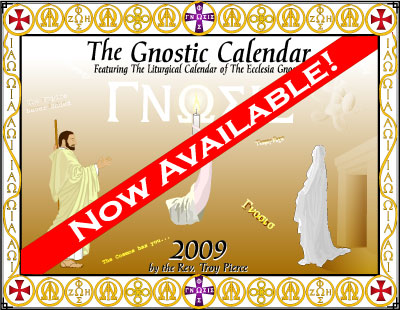
2009 Gnostic Calendar


Now in its fourth year, the first Calendar for Gnostics! Yet, it also appeals to others seeking spiritual liberation.

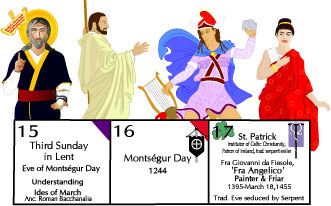
The calendar features the Liturgical Calendar of the Ecclesia Gnostica. Facing pages feature original art and commentary on Gnostic themes by a Gnostic Priest. This year's themes include a series on the Mystery traditions, Simon Magus & Helen, Lazarus, Psyche, Gnosis, and more. It also includes quotes from Gnostic texts and almost all the authors noted. It is truly a unique calendar with a great deal of more content than any other calendar.

Order your 2009 Gnostic Calendar here

Tuesday, September 30, 2008

2009 Gnostic Calendar

The 2009 Gnostic Calendar is in the works. It will be delayed (again) due to illness (again) -- the same illness, unfortunately. This month marks one year of it.

So, hang on to your calendar money for 4-6 weeks. I'll make an announcement when it is time to order.

Phillip Pullman Quote

Religion, uncontaminated by power, can be the source of a great deal of private solace, artistic inspiration, and moral wisdom. But when it gets its hands on the levers of political or social authority, it goes rotten very quickly indeed. The rank stench of oppression wafts from every authoritarian church, chapel, temple, mosque, or synagogue – from every place of worship where the priests have the power to meddle in the social and intellectual lives of their flocks, from every presidential palace or prime ministerial office where civil leaders have to pander to religious ones.

Monday, September 22, 2008

Philosophical view of Gnosis

“I can find nothing on which to hang a world view. The best certainties are either too flimsy or too hard to pin down. The best reasoning is often simply wrong. All the knowledge I have is on its very best days merely provisional.”

Looking for certainty in philosophical propositions in the postmodern era isn't likely to succeed. All formulations of knowledge are provisional, but that is the nature of knowledge since it involves ourselves.

Yet, there is deeper knowledge than the formulations we can make. And while formulations and conclusions are provisional, this deeper knowledge is not. It is simply what cannot be any other way given the shape of our existence. What is certainly true is isomorphic, it cannot be any other way. It is a part of who we are, not something we can directly articulate or determine.

We come to understand more of it by living deeply, by exploring who we are. Knowing oneself in this deep way isn't a pass-time, it is a necessary pursuit -- an investigation into the nature of being. At the same time it is liberating for it frees us of false notions, non-provisional formulations of knowledge, and overreaching conclusions. It is a process of becoming who we truly are and achieving excellence. This is what I call the path of Gnosis, following an ancient understanding.

“You and I might agree, but I'd shy away from the word gnosis. I do like living deeply.”

Unfortunately, there is no equivalent word in English. It is the Greek word originating from the Proto-Indo-European root of gnō. We could use the Sanskrit jnãna, but Indian philosophy developed its terminology somewhat differently from Western philosophy. Of the four words in Greek covering the meanings of "knowledge" in English, gnosis is the most primary and direct: meaning both recognition and investigation.

In the fifth chapter of the Republic, Plato developed his epistemology of types of knowledge. It is generally impossible to make out in English translations, but he is determining what forms of systematic knowledge (epistēmē) and perceptual judgment (doxa, used as a technical term) are based on gnosis.

Whatever terminology we may use to point to this deeper form of knowingness, it is the primary form. Basing certainty at the level of a secondary type of knowing seems inherently flawed, it certainly has failed so far. One can do as Plato did, and try to move from the primary form to a secondary type, but there are severe limitations. In Plato's view one can have systematic knowledge based on gnosis only of noetic content, for example.

In general, this deeper approach takes one beyond the level of cognitive logic and mental "work space" to that which generates/encapsulates them. So, instead of considering contents, one considers the structure of the container. I would also argue that this is a way of understanding notions of no-self. There is no "self" as a being in the way in which we ordinarily understand "self". Yet there is an emulation of a "self" that is a process within a deeper structure.

Tuesday, September 02, 2008

Spirituality in Developmental Perspective

[I thought I'd share part of a paper I wrote last term that may be of interest.]

In recent decades a developmental approach to spirituality has emerged from work in different research areas of adult development. “When investigators of human development have written about 'higher' or more adult stages of development they often indicate that such development is spiritual” (Irwin, 2002, p. 3). Due to these being emergent findings from research that was not aimed at measuring spiritual development, the developmental theories involved do not include recognizably spiritual aspects until the higher stages of development. The theories have yet to adapt their understandings of earlier stages to include this aspect of development that emerges strongly at later stages (Irwin, 2002).

These stage-based developmental theories are sometimes termed “neo-piagetian” because they are extensions of the work done by Piaget on cognitive development in children. Piaget (1950) found that children move through specific stages in how they understand the world around them in the course of their development. The general process of development he described as a process of “decentralization,” a shifting from an egocentric perspective, in which the approach to reality is inseparable from the perspective of the individual, to a more objective perspective.
While Piaget's work ended with the transition into a recognizably adult level of cognition, others have continued to research development into adulthood. Looking at a spectrum of this work, Irwin (2000) summarizes:

Whether we examine moral development or psychosocial development or midlife individuation, the descriptions of higher stages involve characteristics that we can agree are spiritual. It is as if development 'naturally' tends toward spiritual development. That is, spirituality is part of normal or optimal development, and not something unusual or even pathological. In fact, because these stages typically occur in the latter years of life, coming after the earlier stages, spirituality may be considered a higher or more evolved aspect of normal development. We may regard developmental psychology as an emerging psychology, revealing something about spirituality from a new perspective (p. 290)

Even though the higher stages of developmental theories are recognizably spiritual, there is no need to follow Wilber (2000) in treating spirituality according to various definitions as either consisting of these levels or as separate from them. Just as we do not think of cognition as consisting of various stages, nor of developing irrespective of stages, but rather as being expressed within or through the framework of a given stage. At this point in developmental theory, we may not have a term that applies to the same element across all of the stages. For example, Irwin (2002) uses the term “awareness” in the earliest stages, and in later stages the term “consciousness.” For the definition of “consciousness” does not apply in the earliest stages of development (p. 6). We must also bear in mind that developmental stages represent not so much growth, as transformation. This is in fact the distinction between development within a stage, and development to a further stage. The passive state of awareness may grow indefinitely and never attain the active properties of consciousness. If consciousness develops from awareness, then that development is a transformation from one type into another.

This transformational aspect may apply to spirituality. It may be that what is readily recognizable as spirituality in later stages, is not recognizable or definable as spirituality in earlier stages. However, in the range of stages we will be considering, we will be treating spirituality in much the same way as cognition, as something that is expressed within or through a stage, not dependent on it.

Spiritual and Ego Development

Stages can are generally considered in three major categories: preconventional, the stages identified in child development by Piaget; conventional, stages that represent psychosocial development within the range of normal adult function; and postconventional, that describe further development in awareness of the systems involved in the construction of meaning and their innate limitations. Hewlett (2002) includes a further category of transcendent stages. “In this final tier, the separate ego is simply the vehicle through which this deeper reality flows” (p. 34-35).

While there are some differences in the theories of ego development, these can largely be accounted for by differences in the focuses of the theories. For example: Loevinger (1976) and Cook-Greutner (1994, 1999, 2004) worked from measures of meaning-making such as self-understanding; Kegan (1994) focused more on unconscious epistemologies; and Washburn (2003) considered intrapsychic relations and structure as well as relations to body and world. These developmental theories, and the less-encompassing theories of reflective judgment development (King & Kitchner, 1994), moral development (Kohlberg, in King & Kitchner, 1994; & in Irwin, 2002), and faith development (Fowler, 1981), all follow the same structure of “an invariant, hierarchical sequence of distinct views of reality and subject-object integrations which comprise operative, cognitive, and emotional aspects of living” (Cook-Greuter, 1994, p. 121). These stages are not merely progressive, subsequent stages include and increase the perspectives of prior stages.

Growth is not only associated with transitioning to a higher stage. As Cook-Greuter has pointed out, most growth seems to occur within a given stage, “The current ways of viewing reality is refined, enriched, and modified” (p. 120). We can distinguish between growth as change within the framework of a stage, and as transformation in a transition from the current framework to a higher-stage framework.

----
Cook-Greuter, S. (1994). Rare forms of self-understanding in mature adults. In M. Miller & S. Cook-Greuter (Eds.), Transcendence and mature thought in adulthood: Further reaches of adult development. Lanham, MD: Rowman & Littlefield.
Cook-Greuter, S. R. (1999) Postautonomous ego development: A study of its nature and measurement. Ed.D. dissertation, Harvard University, United States -- Massachusetts.
Cook-Greuter, S. (2004). Making the case for a developmental perspective. Industrial and Commercial Training, 36(6/7), 275-281.
Fowler, J. (1981). Stages of faith: The psychology of human development and the quest for meaning. New York: Harper Collins.
Hewlett, D. C. (2004). A qualitative study of postautonomous ego development: The bridge between postconventional and transcendent ways of being. Ph.D. dissertation, Fielding Graduate Institute, United States -- California.
Irwin, R. (2000). Meditation and the evolution of consciousness in M. Miller & A. West (Eds.), Spirituality, ethics, and relationships in adulthood: Clinical and theoretical explorations. Madison, CT: Psychosocial Press.
Irwin, R. (2002). Human development and the spiritual life: How consciousness grows toward transformation. New York: Kluwer Academic/Plenum Publishers.
Kegan, R. (1994). In over our heads: The mental demands of modern life. Cambridge: Harvard University Press.
King, P. & Kitchner, K. (1994). Developing reflective judgment: Understanding and promoting intellectual growth and critical thinking in adolescents and adults. San Francisco: Jossey-Bass.
Loevinger, J. (1976). Ego development: Conceptions and theories. San Francisco: Jossey-Bass.
Piaget, J. (1950). The psychology of intelligence. New York: Routledge.
Washburn, M. (2003). Embodied spirituality in a sacred world. Albany: SUNY Press.
Wilber, K. (2000). Integral psychology: Consciousness, spirit, psychology, therapy. Boston: Shambhala.

Tuesday, May 27, 2008

Pilgrimage to Heresy: A Novel of Gnostic Discovery

Priscillian of Avila was the first Gnostic martyr, he was executed for heresy by the church. Ironically, he may also be at the end of one of the most famous pilgrimages in Europe since the middle ages.

A number of years ago, Lance Owens, medical doctor, historical scholar, and Gnostic priest, went on a pilgrimage in Spain--walking the Caminio de Santiago, the way of St. James. It was a journey filled with wonder and wonderful companions, from which he brought back enthralling stories. During the journey he spoke with a fellow pilgrim about Priscillian, planting the seed of an idea that has now grown into the novel Pilgrimage to Heresy.


More information is at http://pilgrimagetoheresy.com

Also see the new article on Amapedia